
 Harriet Wetton
If you have ever stared at your pool water wondering why it looks dull, cloudy, or why your eyes sting after a quick swim, you are definitely not alone. Pool care can feel like a high school chemistry experiment gone wrong.
In most cases, the mysterious issue behind poor water clarity and skin irritation is total alkalinity. You may have heard that a simple kitchen staple can save the day, but exactly how much baking soda to raise alkalinity in pool water do you need to add to get crystal clear results without causing new problems?
Adding too little sodium bicarbonate will leave your water unstable and acidic, while adding too much can trigger cloudy water, scale formation on pool surfaces, and sky-high pH levels. Balancing pool water is all about precision, patience, and knowing the right math for your specific pool volume.
To raise pool alkalinity naturally, use 1.5 pounds of baking soda per 10,000 gallons of water to increase total alkalinity levels by 10 ppm.
Sodium bicarbonate acts as a gentle buffering agent that stabilizes pH levels, prevents equipment corrosion, and keeps pool water comfortable for swimmers. Always allow the water to circulate for six to eight hours before retesting to ensure your levels sit in the ideal 80 to 120 ppm range.
In this comprehensive guide, we will break down the exact formulas, provide easy-to-use charts, review step-by-step application instructions, and look at common pool maintenance mistakes so you can keep your backyard oasis in pristine condition all season long.
Why Low Alkalinity is a Real Pain for Pool Owners
It is incredibly frustrating when you feel like you are doing everything right with your routine maintenance, yet your pool water still looks dull or feels aggressive on your skin. Low total alkalinity is a silent culprit behind several widespread pool problems that can quickly ruin a weekend swim session with family and friends.
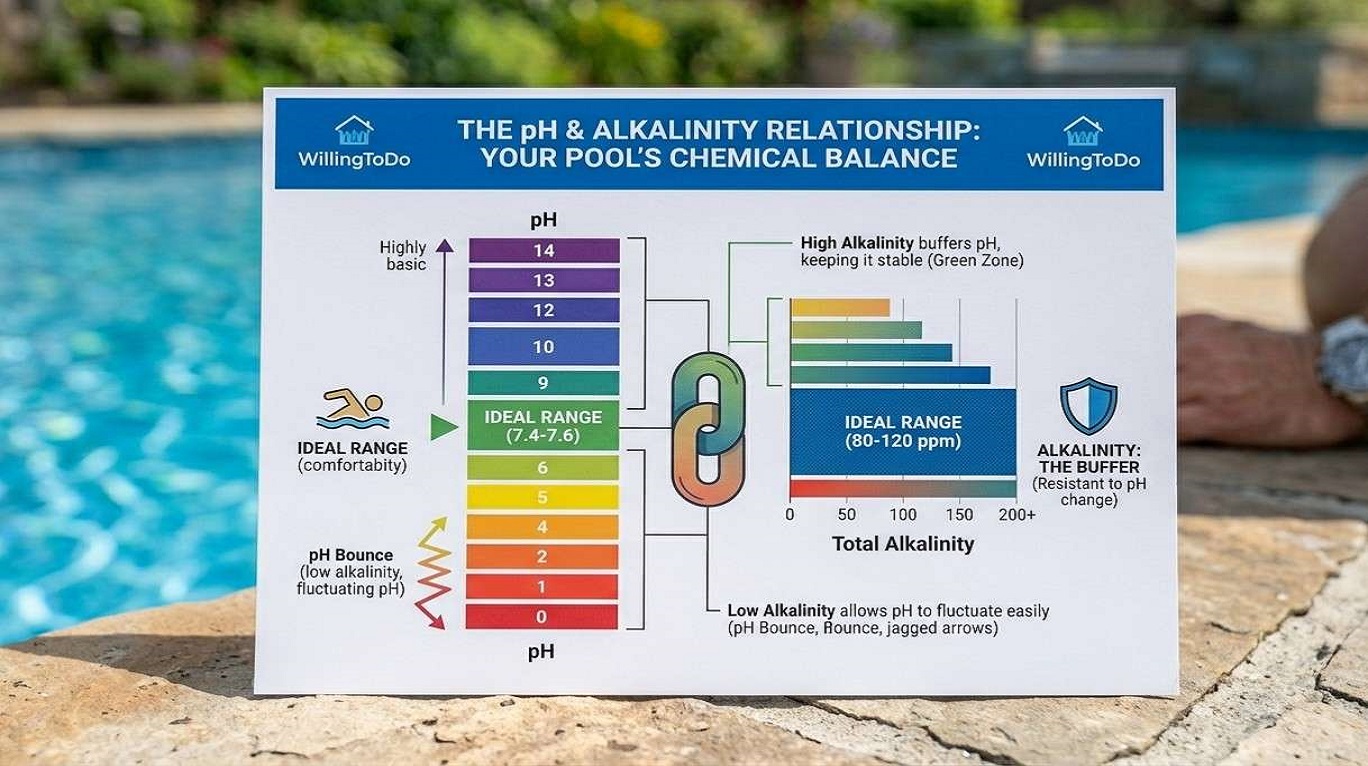
When total alkalinity drops below 80 parts per million (ppm), your pool water loses its natural buffer. Without this chemical backbone, your pH levels will fluctuate wildly in response to minor environmental changes like rainstorms, intense heat, or heavy swimmer usage.
Pool professionals refer to this unpredictable roller-coaster effect as “pH bounce.” One minute your water might test within safe limits, and the next, it turns acidic enough to irritate swimmers and degrade pool hardware.
When alkalinity stays low for an extended period, it triggers several costly chemical and physical issues across your pool environment:
- Corrosion of Metal Components: Acidic, low-alkalinity water eats away at metal ladder rails, pump seals, filter components, copper heat exchangers, and underwater light fixtures.
- Etching and Surface Damage: Concrete, plaster, and gunite pool surfaces experience slow destruction. Low alkalinity water leaches calcium directly out of plaster, leaving pool walls feeling like rough sandpaper and creating unsightly pitting.
- Physical Swimmer Discomfort: Red eyes, dry itchy skin, and burning nasal passages are classic signs that your pool water chemical balance is completely out of alignment.
- Vinyl Liner Deterioration: In vinyl liner pools, persistent low alkalinity can weaken the material, causing vinyl liners to lose elasticity, stretch, and develop premature wrinkles or leaks.
Mastering how much baking soda to add is the most effective way to shield your pool equipment investment, protect pool surfaces, and ensure every splash feels soft and comfortable.
What is Total Alkalinity and Why Does Baking Soda Work?
Before jumping into physical dosage charts and chemistry calculations, it helps to understand how pool chemicals work together. Think of total alkalinity as a shock-absorbing shield for your pH level.
While pH measures how acidic or basic your water is on a scale from 0 to 14, total alkalinity measures the water’s ability to resist sudden shifts in that pH scale.
If that buffering shield is strong, your pH stays steady inside the recommended 7.2 to 7.8 range. If the shield is weak due to low total alkalinity, your pool water becomes hyper-sensitive to external influences like rain, debris, sunlight, and chlorine shock treatments.
Baking soda is chemically known as sodium bicarbonate. It is a natural, non-toxic alkaline powder with a alkaline pH of around 8.3.
Because sodium bicarbonate shares the exact same active chemical composition as commercial “alkalinity increaser” products sold in pool supply shops, it works as a budget-friendly alternative. It safely boosts total alkalinity while having a relatively mild, gradual impact on overall pH levels.
How Much Baking Soda to Raise Alkalinity in Pool Water?
Calculating the precise amount of pure baking soda needed for your swimming pool comes down to two basic factors: your pool’s total water capacity in gallons and the current total alkalinity reading measured in ppm.
The Core Dosage Formula: Use 1.5 pounds (or approximately 24 ounces) of sodium bicarbonate per 10,000 gallons of pool water to raise total alkalinity by 10 ppm.
To help you visualize what your pool needs without requiring complex math every single time, here is a detailed dosage chart organized by common pool capacities and target alkalinity increases.
Baking Soda Dosage Chart
| Pool Volume (Gallons) | To Raise 10 ppm | To Raise 30 ppm | To Raise 50 ppm |
|---|---|---|---|
| 5,000 | 0.75 lbs | 2.25 lbs | 3.75 lbs |
| 10,000 | 1.5 lbs | 4.5 lbs | 7.5 lbs |
| 15,000 | 2.25 lbs | 6.75 lbs | 11.25 lbs |
| 20,000 | 3 lbs | 9 lbs | 15 lbs |
| 25,000 | 3.75 lbs | 11.25 lbs | 18.75 lbs |
| 30,000 | 4.5 lbs | 13.5 lbs | 22.5 lbs |
Expert Tip: Never add more than 2 pounds of baking soda per 10,000 gallons of water in a single application. Adding massive doses all at once can cause severe, temporary cloudiness and lead to scale precipitation. Split larger required doses into smaller treatments spaced several hours apart.
How Do I Calculate Baking Soda for My Pool Volume?
To calculate the exact weight of baking soda required for your setup, start by measuring your pool water capacity and checking your baseline water test results. Ideal total alkalinity levels should fall between 80 and 120 ppm for standard chlorine pools, and between 100 and 140 ppm for pools using salt chlorine generators.
If you need to boost your alkalinity levels, use this straightforward math formula:
(Pool Gallons ÷ 10,000) × (Desired PPM Increase ÷ 10) × 1.5 = Pounds of Baking Soda Needed
For example, if you own a 20,000-gallon pool and your test kit reveals an alkalinity level of 60 ppm, you will want to target an increase of 30 ppm to reach a healthy 90 ppm balance. Plugging these numbers into our formula gives:
(20,000 ÷ 10,000) × (30 ÷ 10) × 1.5 = 2 × 3 × 1.5 = 9 Pounds of Baking Soda
For additional guidance on maintaining wellness routines and personal home care habits, review our article on building a healthy daily routine to keep all your household maintenance organized effortlessly.
Step-by-Step Guide to Adding Baking Soda to Your Pool
Adding baking soda to your pool requires more than simply dumping a box over the edge. Following proper distribution techniques prevents chemical settling, protects your pool floor from staining, and ensures the sodium bicarbonate integrates evenly throughout the entire body of water.
1. Conduct a Baseline Water Test
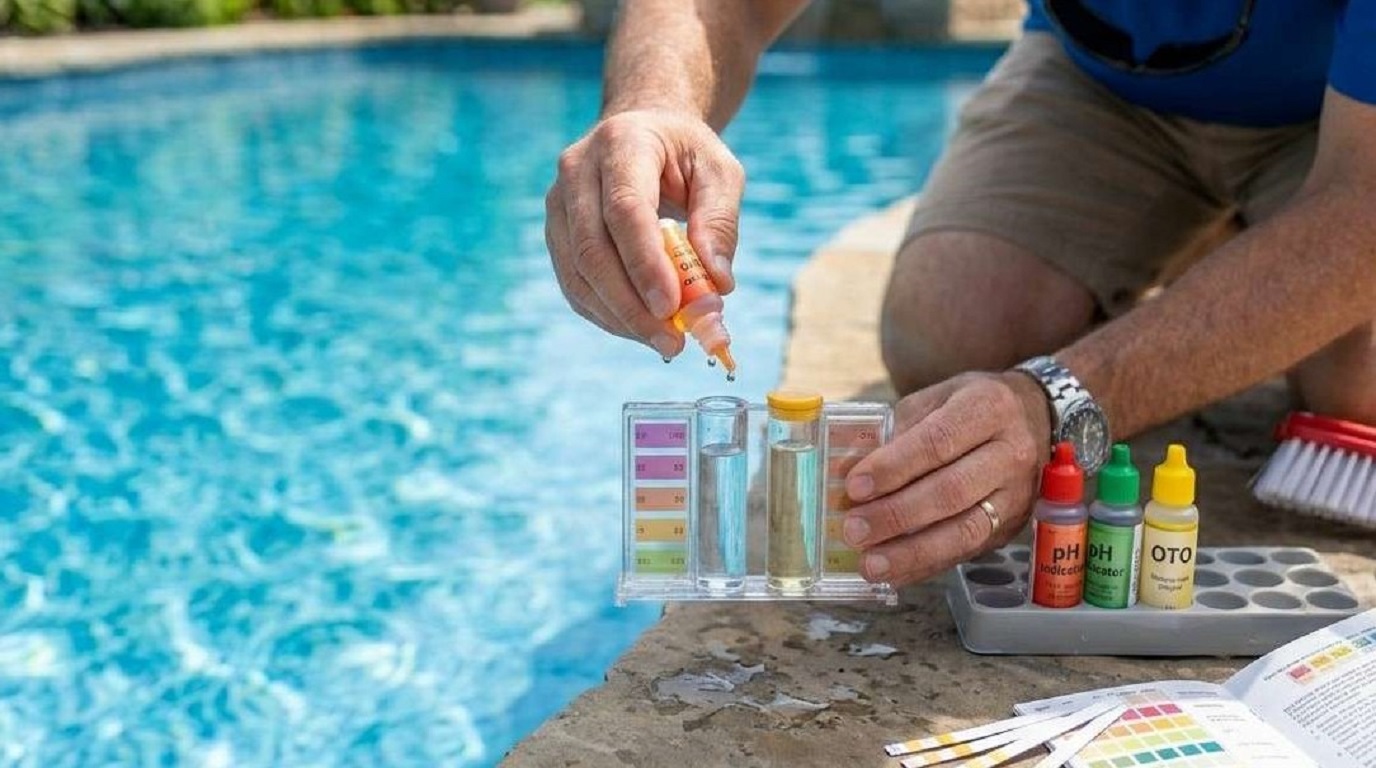
Before opening any chemical bags, collect a water sample from elbow-depth away from pool return jets. Use a reliable liquid drop test kit (such as FAS-DPD) or fresh test strips to check your current total alkalinity and pH levels.
Double-check that your cyanuric acid (stabilizer) and calcium hardness levels are also within normal ranges, as these can influence water balance overall.
2. Calculate Total Chemical Volume
Use the reference dosage table above or apply the manual formula. If you are uncertain about the exact volume of water in your pool, estimate rectangular pool capacities using this basic formula: Length × Width × Average Depth × 7.5. For round above-ground pools, use: Diameter × Diameter × Average Depth × 5.9.
3. Apply Partial Doses (The 75 Percent Rule)
Chemical reactions can vary based on water temperature, current pH, and existing mineral content. It is always best practice to apply approximately 75 percent of your total calculated dosage during your initial treatment. Raising total alkalinity gradually is far easier than trying to lower high alkalinity after overshooting your target.
4. Proper Distribution Around the Perimeter
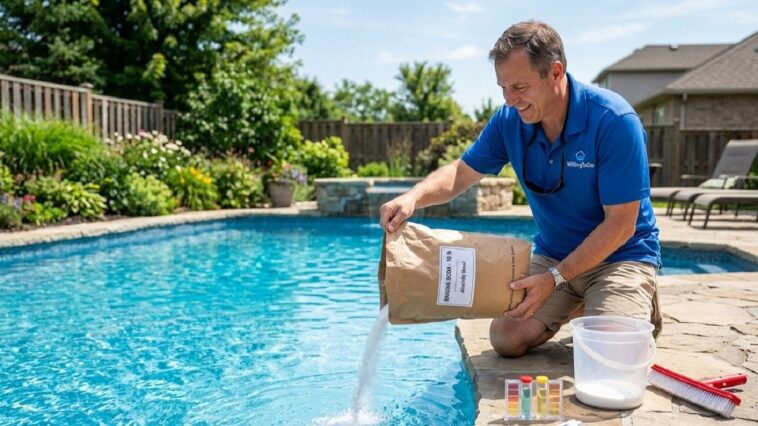
Turn on your pool pump to full filtration mode. Turn off any automatic pool cleaners or fountain features. Slowly pour the dry baking soda powder directly into the deep end or walk along the deep-water perimeter, scattering the powder evenly over the water surface.
Avoid pouring large clumps near skimmer boxes or main drains to prevent undissolved sodium bicarbonate from entering your pool filter system directly.
5. Allow Full System Circulation
Let your filtration pump run continuously for at least 6 to 8 hours after adding baking soda. This active circulation spreads the buffer across all areas of the pool, preventing dense pockets of heavy alkaline water from sitting near the bottom.
6. Retest and Adjust
Once 8 hours of circulation have passed, collect a fresh water sample and test your total alkalinity and pH levels once more.
If your readings are sitting comfortably between 80 and 120 ppm, your water balance is restored! If levels remain below 80 ppm, calculate and apply the remaining dosage needed using the exact same application steps.
Real-Life Example: Fixing a Rain-Diluted Pool
Consider a real-world scenario involving a pool owner named Lavilla, who manages a 15,000-gallon above-ground pool. Following several days of heavy summer rainstorms, her water appeared slightly hazy.
A quick water test revealed that her total alkalinity had dropped down to 60 ppm, while her pH was sitting at a low 7.0.
Lavilla wanted to boost her total alkalinity level up to 100 ppm, requiring a total increase of 40 ppm.
- Step 1 (Base Calculation): To raise a 10,000-gallon pool by 10 ppm requires 1.5 lbs of baking soda.
- Step 2 (Adjusting for Volume): For a 15,000-gallon pool, boosting alkalinity by 10 ppm requires 2.25 lbs of baking soda (1.5 × 1.5).
- Step 3 (Target Increase): To achieve her target 40 ppm increase, Lavilla multiplied 2.25 lbs by 4 (since 40 ppm represents four 10 ppm increments).
- Step 4 (Total Amount Required): 2.25 lbs × 4 = 9 lbs total of baking soda.
Instead of dumping all 9 pounds into her pool at once, Lavilla wisely added 5 pounds on Saturday morning. She let her circulation pump run all day and retested her water Sunday morning, finding her total alkalinity at 85 ppm.
Satisfied with the baseline, she added another 2 pounds to settle right in the optimal 100 ppm sweet spot, reserving her remaining powder for future routine top-offs. Her pool water remained sparkling clear, and her pH levels stabilized immediately.
Common Mistakes to Avoid When Adding Baking Soda
Even seasoned pool owners can fall into bad pool care habits. Avoiding these critical chemical mistakes will save you time, effort, and money during pool maintenance sessions:
- Mixing Baking Soda Direct with Chlorine: Never pre-mix baking soda directly with liquid chlorine, shock treatments, or trichlor pucks inside a bucket.While both chemicals are safe when diluted inside thousands of gallons of pool water, combining them in concentrated physical forms can trigger volatile chemical reactions or release harmful gases. Always treat chemicals separately.
- Confusing Baking Soda with Washing Soda: Baking soda (sodium bicarbonate) and washing soda (sodium carbonate or soda ash) are distinctly different products. Washing soda has a very high pH level of around 11.It will dramatically spike your pH levels far faster than it raises alkalinity. Always verify that your bag reads 100 percent pure sodium bicarbonate.
- Ignoring High pH Levels: Adding large amounts of baking soda will cause a minor upward shift in your pool’s overall pH. If your pH levels are already sitting high (above 7.8), correct your pH using muriatic acid or dry acid before adding significant amounts of baking soda.
- Neglecting Physical Brushing: If you notice fine white powder settling at the bottom of your pool floor after application, use a soft pool brush immediately to sweep the product around.Sweeping speeds up dissolution and prevents concentrated chemical buildup on pool surfaces. If you are looking for tips on managing outdoor tasks efficiently, take a look at our guide on maintaining trees on your property.
- Over-treating Cloudy Water: If your pool turns slightly hazy after pouring in sodium bicarbonate, do not immediately add secondary chemicals like clarifiers or flocculants.Mild cloudiness is normal during treatment and usually clears up within 4 to 6 hours as the powder dissolves fully and circulates through your filter system.
Expert Tips for Best Results with Pool Chemistry
To optimize your maintenance routine and maximize every bag of sodium bicarbonate you purchase, keep these practical expert tips in mind:
- Buy Commercial Bulk Quantities: Skip the tiny 1-pound baking boxes in the grocery store baking aisle.
Purchase 10-pound, 12-pound, or 50-pound bags of pure sodium bicarbonate from home improvement stores, warehouse clubs, or agricultural suppliers. It is identical chemically and vastly cheaper per pound. - Account for Weather and Heavy Usage: Heavy rainstorms drop naturally acidic rainwater into your pool, which rapidly drains your total alkalinity. Similarly, large pool parties introduce sweat, sunscreen, and organic waste that consume pool buffers.Always test your pool chemistry after major rain events or heavy weekend use. For overall physical wellness tips after spending hot summer days outside, check out our insights on how to stay hydrated throughout the day.
- Maintain Routine Testing Schedule: Test total alkalinity once a week during active swimming seasons. Fixing a small 10 ppm drop early requires far less effort than trying to recover from a massive crash where total alkalinity falls below 40 ppm.
- Store Chemicals in Dry Environments: Sodium bicarbonate readily absorbs ambient moisture from humid air. Store opened bags inside airtight plastic buckets in a cool, dry shed or garage to prevent heavy clumping.
How Alkalinity Fits into Your Total Pool Care Strategy
Understanding how much baking soda to raise alkalinity in pool water is just one piece of your broader pool maintenance puzzle. Proper pool chemistry balances five main components to keep water safe, clear, and comfortable:
- pH Levels: Target 7.2 to 7.8 (Optimal: 7.4 to 7.6)
- Total Alkalinity: Target 80 to 120 ppm (100 to 140 ppm for saltwater systems)
- Free Available Chlorine: Target 1.0 to 3.0 ppm
- Calcium Hardness: Target 200 to 400 ppm
- Cyanuric Acid (Stabilizer): Target 30 to 50 ppm
Think of total alkalinity management as your foundational baseline. When total alkalinity is balanced correctly, maintaining healthy pH levels and active chlorine sanitizers becomes significantly easier and requires fewer chemical adjustments overall.
If you want to master the entire pool management process and eliminate persistent water balance issues, check out our comprehensive core guide on how to raise alkalinity in pool water.
It breaks down advanced chemical balancing tactics, equipment maintenance, and step-by-step winterization routines. You can explore complete home care strategies on our site to elevate your routine and maintain your outdoor space with total confidence.
When to Seek Professional Pool Service Help
For most residential pool owners, restoring total alkalinity using grocery store baking soda or sodium bicarbonate powder is a simple DIY task. However, if your total alkalinity levels drop continuously despite regular dosage additions, you may be facing an underlying technical problem.
Persistent drops in total alkalinity can indicate undetected pool leaks that continually replace balanced pool water with fresh, unbuffered tap water.
Extremely stubborn water clarity issues, persistent black algae growth, or recurring surface scaling may also indicate high total dissolved solids (TDS) or severe cyanuric acid lockup. In these complex scenarios, scheduling a comprehensive professional water test with a certified pool service technician can save you hours of guesswork and preserve your equipment for years to come.
Conclusion
Learning how much baking soda to raise alkalinity in pool water does not need to involve guesswork or complicated formulas. By following the standard dose of 1.5 pounds of baking soda per 10,000 gallons of water for every 10 ppm increase, you can safely, effectively, and affordably balance your pool water chemistry.
Remember to add chemicals slowly, run your circulation pump continuously, retest after six to eight hours, and keep your total alkalinity between 80 and 120 ppm.
For more practical home guides, clear lifestyle tutorials, and expert tips on maintaining your living space, keep following WillingToDo. We provide clear, reliable advice to help you solve everyday home maintenance challenges with complete confidence!
Frequently Asked Questions
1. Can I swim immediately after adding baking soda to my pool?
Yes, it is generally safe to swim roughly 30 to 60 minutes after adding baking soda to your pool, provided the powder has fully dissolved into the water and your filtration pump is actively running. Sodium bicarbonate is a mild, non-toxic compound that will not harm skin or eyes when properly diluted in pool water.
2. Will adding baking soda raise my pool’s pH level too high?
Baking soda has a natural pH of around 8.3, so it will raise your pool’s pH level slightly, but its main effect is raising total alkalinity. If your goal is to significantly raise your pH without making major changes to your total alkalinity levels, you should use soda ash (sodium carbonate) instead of baking soda.
3. Is household grocery baking soda identical to pool store alkalinity increaser?
Yes, household baking soda and commercial pool “alkalinity increaser” products contain the exact same active chemical ingredient: 100 percent sodium bicarbonate. The only difference between them is the brand packaging, weight sizes, and price per pound.
4. What happens if I accidentally add too much baking soda to my pool?
Adding too much baking soda will push both your total alkalinity and pH levels above safe limits (exceeding 140 ppm TA). This over-saturation can lead to cloudy pool water, reduced chlorine sanitizer efficiency, and scale deposits forming along pool tiles, plumbing, and heater elements.
You will need to add small doses of muriatic acid or dry acid (sodium bisulfate) to bring high alkalinity levels back down into safe ranges.
5. How often should I test my pool’s total alkalinity?
You should test your pool’s total alkalinity at least once a week during the active swimming season. Additionally, you should run a water test after heavy rainstorms, periods of high pool usage, or whenever you notice changes in water clarity or swimmer comfort.
6. Can I pour baking soda directly into my pool skimmer box?
It is best to avoid dumping large amounts of dry baking soda directly into your pool skimmer box. Concentrated amounts of undissolved powder can travel straight into your pool filter and pump basket, potentially causing temporary filter clogging or localized chemical spikes inside your equipment. Always broadcast the powder around the perimeter of the deep end instead.